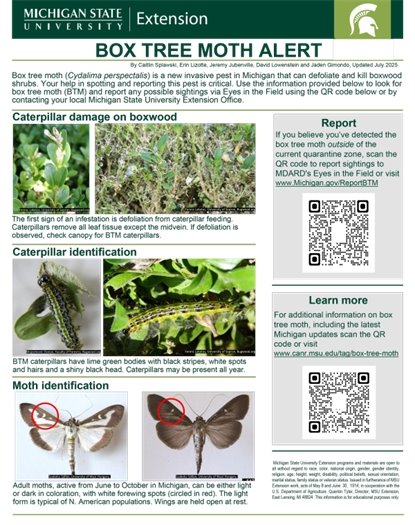
Boxwoods and Box Tree MothsBoxwoods are an extremely popular shrub in landscaping. Their persistent leaves and ability to withstand frequent pruning, as well as their unattractiveness to deer grazing, has made them omnipresent across the region. Unfortunately, a predator has made its way here and causes severe problems for Boxwoods. That predator is the Box Tree Moth. The box tree moth originates from northern Asia and far east Russia and India, and boxwoods are also native to that area, as well as others. The box tree moth likely came to the United States in infested boxwood plants imported here from other countries. There has been a quarantine against transporting boxwoods out of a number of southeastern Michigan counties where it has been found, but as Wayne County is one of the counties where contaminated plants were shipped, that quarantine has not protected Livonia as we are getting multiple reports of major boxwood damage this year. The moth defoliates the bush. While it may come back from an initial infestation, repeated infestations may weaken the plant to the extent that it dies over time. For a complete discussion of the problem, see the MSU extension service Web page. If you have found it in your yard (either through direct observation of adults or caterpillars), there are some things you can do to help your boxwoods. One is to use a preventative pesticide spray to protect them as noted on the above website. Another option is to spray a Bacillus thuringiensis (Bt) product on the shrubs. The problem with many pesticides is that they kill “helpful” or “good” caterpillars and other insects along with the bad. Even if you only spray a boxwood, where monarch caterpillars and other desirable moth and butterfly larvae aren’t likely to be, the chemical can drift to other nearby plants where they might be, so be careful when applying them to not do it on a windy day, and only spray away from non-boxwood plants toward the boxwoods to reduce the chance of drift to other plants and potentially other desirable creatures. This is also a good time to learn again the problem with monoculture planting. When a problem such as Dutch elm, Emerald Ash Borer or now the Box Tree Moth arise, having lots of the same plant makes it easier for the scourge to move from one plant to another, possibly decimating the entire planting. Alternatives to boxwoods are also available that will add diversity to your yard, and add interest, color and other benefits to your yard. Consider using some of these instead of boxwoods (new or replacements) to avoid the box tree moth problem. If boxwood blight is confirmed, remove and destroy infected plants and any plant debris by double bagging the diseased material and disposing of it in a landfill. We recommend that residents be advised to use contractor bags and place the bags into their regular trash carts. If there is no room in the cart, then the bags should be placed next to the trash carts and cans, away from any yard waste. It may also be helpful to label the bags material as “boxwood trash.” For more information on box tree moths, visit the links below: |
|
|
|

 Share on Facebook
 Share on Twitter
 Share via Email
